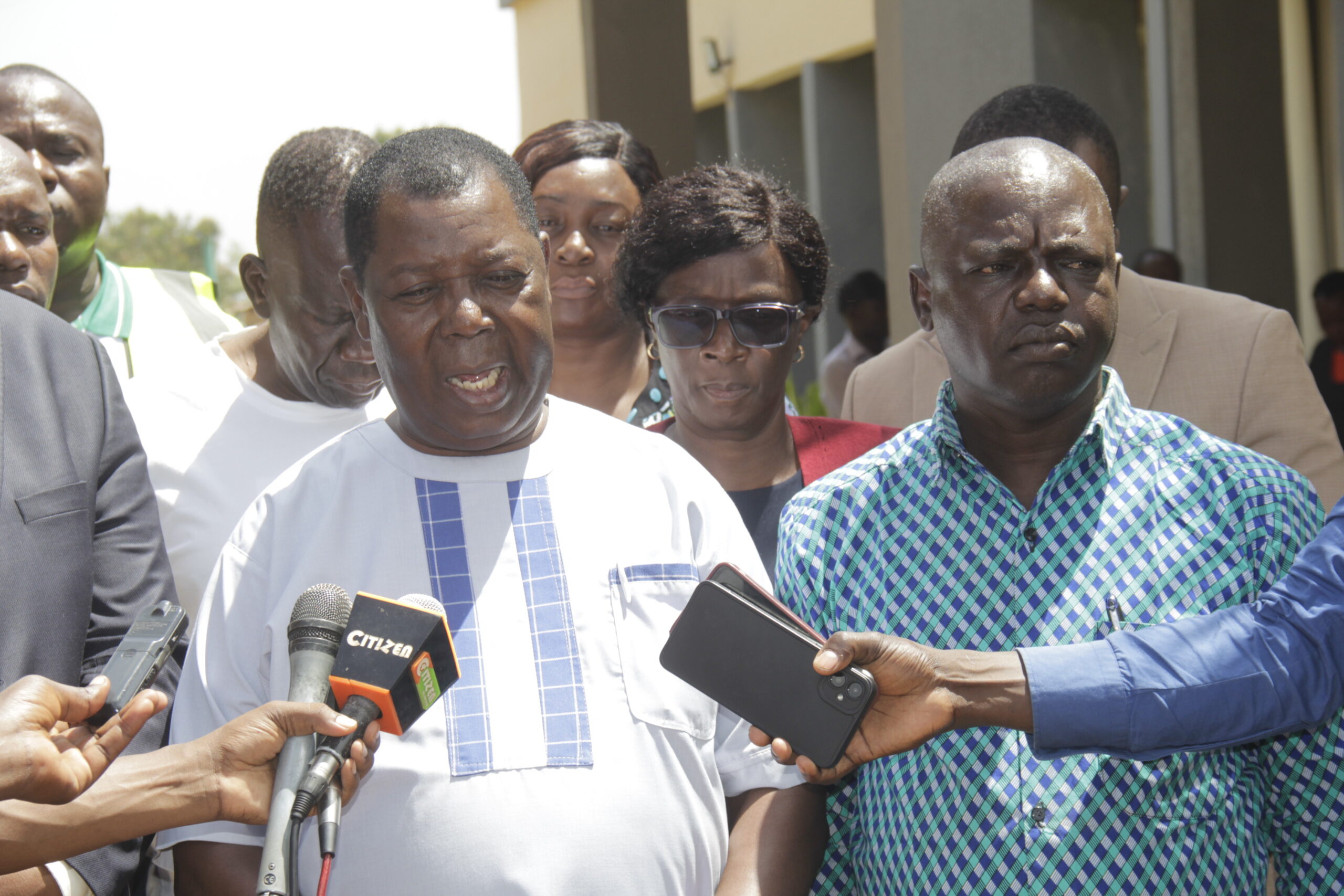
County Executive Committee Member (CECM) for Finance and Economic Planning Andrew Nakitare addressing the media after appearing before the county Committee on Finance and Economic Planning led by its chairperson Alexander Ayieko
Busia County, Kenya: Busia County is witnessing a dramatic surge in its own-source revenue collections, driven by a series of reforms designed to tap into an estimated potential of Ksh 2 billion annually.
The progress was detailed by senior county officials following an appearance before the County Assembly’s Committee on Finance and Economic Planning.
Chief Officer for Finance and Economic Planning, Timothy Odende, reported that strategic interventions have successfully addressed long-standing inefficiencies in revenue collection. “We have already surpassed our first-quarter target,” Odende stated. “Against an annual goal of Ksh 707 million, or roughly Ksh 176.8 million per quarter, we have collected Ksh 235 million. We are confident this positive trend will continue into the second quarter.”
Odende credited a consistent upward trajectory since Governor Paul Otuoma’s administration began in 2022. “Revenue stood at Ksh 292 million when the Governor took office. After overhauling the system, collections rose to Ksh 369 million that year, climbed to nearly Ksh 400 million the next, and surpassed the half-billion mark with Ksh 507 million last year,” he explained.
County Executive Committee Member (CECM) for Finance and Economic Planning Andrew Nakitare addressing the media after appearing before the county Committee on Finance and Economic Planning led by its chairperson Alexander Ayieko.
County Executive Committee Member (CECM) for Finance and Economic Planning, Andrew Nakitare, emphasized the county’s untapped potential. “Studies by the Commission on Revenue Allocation and others indicate a capacity of up to Ksh 2 billion,” Nakitare said. “Key reforms—including transitioning to a cashless system, establishing an independent revenue department, and implementing a coordination framework—have curbed leakages and fostered transparency.”
A significant temporary change has seen county administrators take over collection duties while revenue officers undergo fresh vetting by the County Public Service Board. “Since administrators assumed this role, we have seen a sharp increase in collections,” Nakitare noted, suggesting that previous systems may have been compromised. “Officers found unsuitable will be redeployed.”
Committee Chairperson Alexander Ayieko acknowledged the evident improvements. “The officials have demonstrated clear progress,” Ayieko said. “We have been briefed on forward-looking plans, including a draft bill for border point service fees on trucks and the establishment of a professional Busia County Revenue Board to oversee collections.”
We use cookies on our website to give you the most relevant experience by remembering your preferences and repeat visits. By clicking “Accept”, you consent to the use of ALL the cookies.
This website uses cookies to improve your experience while you navigate through the website. Out of these, the cookies that are categorized as necessary are stored on your browser as they are essential for the working of basic functionalities of the website. We also use third-party cookies that help us analyze and understand how you use this website. These cookies will be stored in your browser only with your consent. You also have the option to opt-out of these cookies. But opting out of some of these cookies may affect your browsing experience.
Necessary cookies are absolutely essential for the website to function properly. These cookies ensure basic functionalities and security features of the website, anonymously.
Cookie
Duration
Description
cookielawinfo-checbox-analytics
11 months
This cookie is set by GDPR Cookie Consent plugin. The cookie is used to store the user consent for the cookies in the category "Analytics".
cookielawinfo-checbox-functional
11 months
The cookie is set by GDPR cookie consent to record the user consent for the cookies in the category "Functional".
cookielawinfo-checbox-others
11 months
This cookie is set by GDPR Cookie Consent plugin. The cookie is used to store the user consent for the cookies in the category "Other.
cookielawinfo-checkbox-necessary
11 months
This cookie is set by GDPR Cookie Consent plugin. The cookies is used to store the user consent for the cookies in the category "Necessary".
cookielawinfo-checkbox-performance
11 months
This cookie is set by GDPR Cookie Consent plugin. The cookie is used to store the user consent for the cookies in the category "Performance".
viewed_cookie_policy
11 months
The cookie is set by the GDPR Cookie Consent plugin and is used to store whether or not user has consented to the use of cookies. It does not store any personal data.
Functional cookies help to perform certain functionalities like sharing the content of the website on social media platforms, collect feedbacks, and other third-party features.
Performance cookies are used to understand and analyze the key performance indexes of the website which helps in delivering a better user experience for the visitors.
Analytical cookies are used to understand how visitors interact with the website. These cookies help provide information on metrics the number of visitors, bounce rate, traffic source, etc.
Advertisement cookies are used to provide visitors with relevant ads and marketing campaigns. These cookies track visitors across websites and collect information to provide customized ads.