|
Getting your Trinity Audio player ready...
|
By Winnie Kamau
Nairobi, Kenya: African governments and technology stakeholders have welcomed the significant victory in global digital policy after the United Nations adopted the WSIS+20 outcome document by consensus on 17 December 2025, firmly embedding African priorities into the future of global Internet governance.
The landmark resolution extends the mandate of the World Summit on the Information Society (WSIS) and the Internet Governance Forum (IGF) for another ten years, until 2035, while also granting the IGF a permanent mandate, ensuring long-term continuity of the multistakeholder model.
In a message to Africa’s technology community, Dr. Mactar Seck of the UN Economic Commission for Africa (UNECA) described the decision as a historic milestone.
“The adoption by consensus of the WSIS+20 outcome document marks a historic milestone for global Internet governance,” Dr. Seck said, noting that the agreement reflects years of sustained African engagement.
The high-level review process was jointly guided by two United Nations Ambassadors, who were specifically appointed by the President of the UN General Assembly.
They played a vital role in leading consultations, negotiations, and consensus-building among Member States and other stakeholders. Their efforts were crucial in reconciling diverse perspectives, incorporating the specific needs of developing regions especially in the Global South and ultimately gaining broad commitment to the final result.
These co-facilitators are Her Excellency Ambassador Suela Janina of Albania and His Excellency Ambassador Ekitela Lokaale of Kenya.
African priorities embedded
Crucially for the continent, the final document incorporates priorities articulated by African stakeholders through the Cotonou Declaration on WSIS+20 and the Africa Internet Governance Forum (AfIGF) Dar es Salaam Declaration, including digital inclusion, development-oriented governance, and meaningful participation of developing countries.
“The outcome document now fully incorporates African priorities,” Dr. Seck said,
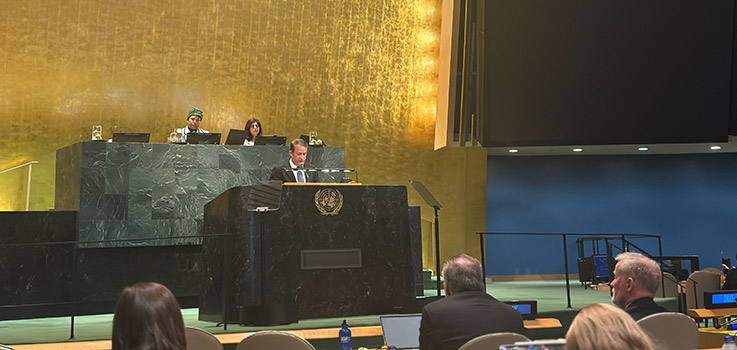
Dr. Jimson Simulufie from the, Africa ICT Alliance speaking at the UN General Assembly of WSIS Plus20 noted that The need for security on the Internet, governance, and respect for human rights are more necessary than ever.
“I would like to congratulate the facilitators from Romania and Kenya, UNDESA, and the member states for the success of the examination of the results of the Information Society Summit. Your Excellencies, the Summit began recognizing the multiple nature of the information society and continues to be demonstrated by the creation of the IMSB. We hope to maintain this momentum. This is a testimony of the need to promote digital cooperation for sustainable development in the era of artificial intelligence.
Adding “We have to close the digital gap in countries and between countries, and free resources for greater digitalization and digital literacy so that no one is left behind. This is proof of our collective vision and our commitment to advance the common good of humanity” he said.
Permanent IGF mandate welcomed
The establishment of a permanent mandate for the IGF was widely welcomed by African stakeholders, who have long advocated for stability and predictability in global Internet governance processes.
“This ensures long-term continuity for the multistakeholder model,” Dr. Seck said, adding that it strengthens inclusive dialogue among governments, industry, civil society and the technical community.
In welcoming the news from the UNGA meeting in New York “Congratulations to all advocates and Africans, with sincere appreciation to the AfIGF Secretariat, UNECA, the African Union, and all partners for their leadership. This achievement reflects the strength and unity of a powerful multistakeholder engagement, for the benefit of today’s youth and future generation” said Dr. Khouzeifi Issakha Doud-bane TChad Youth Internet Governance Forum.
From Tanzania Internet Governance Forum “Thank you for being an outstanding African troops leader” Dr. Nazarious Nicholas of Tanzania IGF
The resolution also outlines how the Global Digital Compact (GDC) , a key UN framework for digital cooperation, will be implemented, creating new opportunities for African countries to align digital transformation with development goals.
UNECA commits to implementation
Dr. Seck emphasized that adoption of the document is only the beginning, stressing the need to translate commitments into tangible outcomes for African citizens.
“UNECA will continue to collaborate with all member states, the private sector, civil society, the technical community, and academia to translate the WSIS+20 vision into concrete actions,” he said.
Analysts say this focus on implementation is critical as Africa grapples with persistent digital divides, high connectivity costs, skills gaps and uneven access to digital public infrastructure.
Looking ahead to 2026
Attention is now turning to the next phase of continental engagement, with preparations set to begin for AfIGF 2026 and the Africa WSIS Review 2026, which will assess progress and set priorities for the coming decade.
“Let us now begin preparations for AfIGF 2026 and the Africa WSIS Review 2026,” Dr. Seck urged, calling on Africa’s tech and policy communities to sustain momentum.
For Africa, the WSIS+20 outcome marks not just a diplomatic success, but a chance to shape a digital future that is inclusive, development-driven and firmly anchored in African realities.