|
Getting your Trinity Audio player ready...
|
By Arasha Soila
Nairobi, Kenya: Fifteen years after the promulgation of Kenya’s progressive 2010 Constitution, the dream of equitable political representation remains unfulfilled, according to a report released by the Association of Media Women in Kenya (AMWIK) in partnership with Friedrich Naumann Foundation (FNF).
The report highlights that Kenya currently lags behind regional peers like Rwanda, Tanzania, and Uganda, which successfully employ enforceable quotas and stricter party accountability to achieve higher women’s representation. Despite the constitutional mandate for the two-thirds gender rule, women hold only 23.9% of elective seats in Parliament, a figure far below the required threshold.
The persistence of this gap is directly linked to the overwhelming campaign costs and weaponized online violence imposed on female aspirants excluding them from competitive political races.
Kenyan elections are characterized as among the most expensive globally, demanding billions of Kenya shillings for presidential and gubernatorial campaigns, and tens of millions for senatorial or national assembly bids. This high cost of politics is financially crippling, excluding women who typically lack equal access to the male-dominated networks of campaign finance.
Furthermore, political parties levy high nomination fees, which are often intended to discourage candidates deemed “unserious,” effectively keeping women and youth away from active political participation. For women from marginalized communities, the combination of marginalization, poverty, and these prohibitive costs has caused them to refrain completely from seeking office. These high costs act as indirect deterrents, blocking women’s right to contest elections.
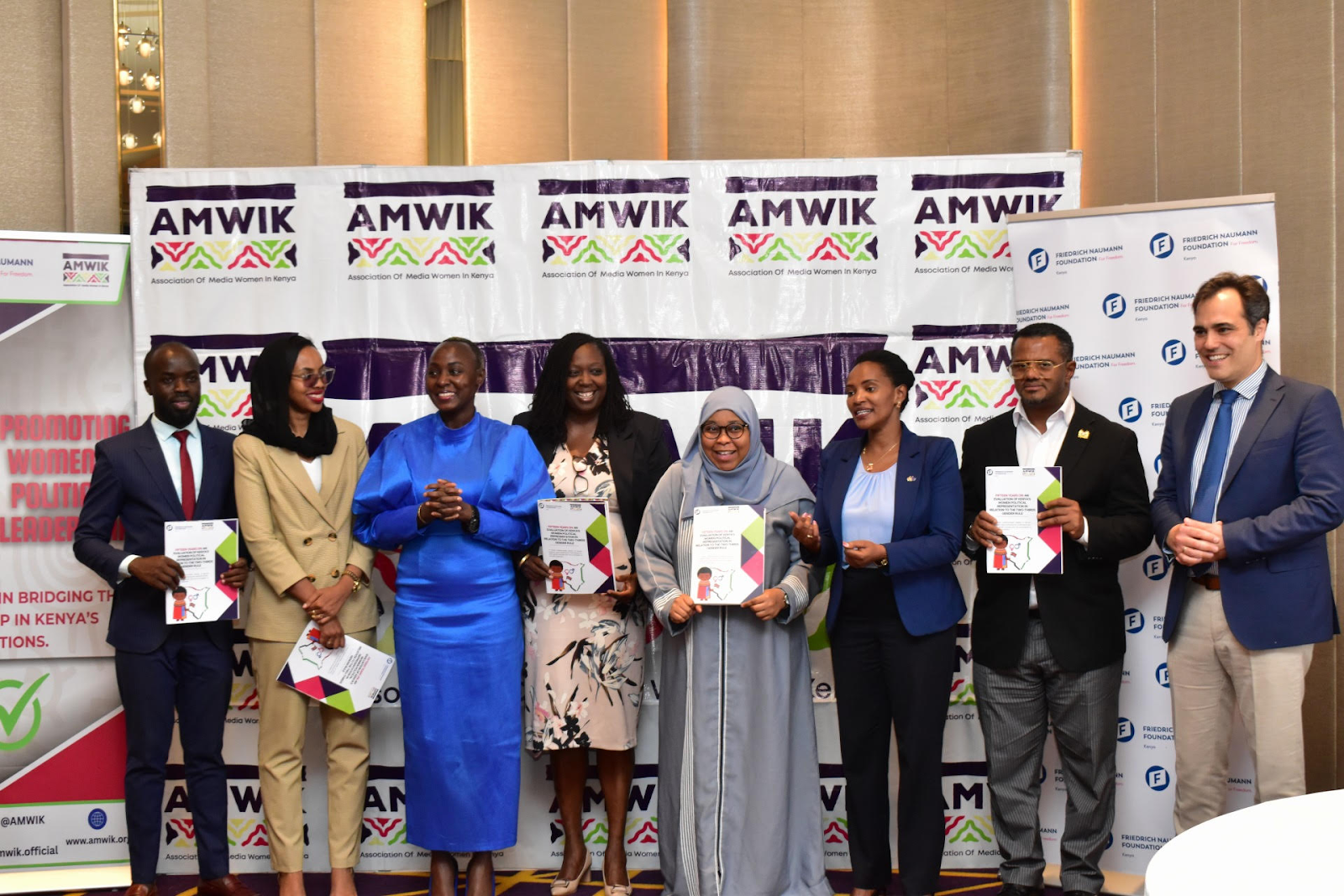
Stakeholders during the launch of the report
Speaking during the launch of the report, Ralf Erbel, Director, FNF East Africa and Global Partnership said that supporting women in political leadership is not just a matter of fairness, it is central to building more accountable democratic institutions.
He emphasised by saying that democracy cannot thrive without the inclusion of women and governance improves significantly when women sit at the decision making table.
To counter the exorbitant cost of politics, which financially cripples aspirants, parliament must introduce decisive legislation. Specifically, the report urges lawmakers to cap nomination fees and introduce a legal ceiling on campaign expenditure to prevent the exclusion of both women and youth from seeking office.
IEBC Vice Chairperson, Fahima Araphat Abdallah reaffirmed the Commission’s commitment to supporting inclusive, free and fair elections. “To ensure a fair environment for everyone, the IEBC has proposed a 50% waiver on nomination fees for women, the youth, and persons living with disabilities. We are also proposing legal reforms to empower the IEBC to reject lists from political parties that fail to adhere to the two-thirds gender rule,” she stated.
The report further calls on the Office of the Registrar of Political Parties (ORPP) to legally require political parties to institutionalize gender-responsive nomination rules and tie compliance to funding allocations as a condition of registration. This should include allocating minimum quotas for women in competitive seats.
In her remarks, AMWIK’s Executive Director, Queenter Mbori, highlighted that there’s overwhelming evidence justifying why the participation of women in politics and governance has positive effects especially on resource allocation and ensuring service priorities are met for all.
“We need to introduce legal mechanisms for state funding and subsidies specifically for women candidates to neutralize the financial barriers to entry. The lack of a critical mass of women in political institutions leads to decision making progresses that are not inclusive and equitable leading to a society where prosperity is not shared by all.” Quenteer asserted.
Additionally the media has been urged to conduct continuous civic education to sensitize voters on the electoral processes and incentivize them to elect women and men equitably based on their development agenda and leadership credentials.
“Women leadership is not a favor to be granted but is instead a democratic necessity and a national imperative. The 2027 elections must be the moment when Kenya moves from intention to implementation and from aspiration to actualization regarding women’s political leadership, “ stressed Hassan Omar, Senator, Mombasa County.
Omar underscored the need for a structured way to bridge funding gaps. He pointed out that structured empowerment programs should be implemented to fund women political leaders. “This funding should cover practical, incidental costs, such as helping women organize their secretariats, planning, mobilization tools, and paying for agents to safeguard your votes during the election period,” he emphasized.
The findings serve as a clarion call, urging stakeholders to use this evidence-based roadmap to finally transform the constitutional principle into a political reality before the 2027 General Elections.