|
Getting your Trinity Audio player ready...
|
By Diana Chiyangwa
There is no UN Convention that prohibits Ethiopians from seeking asylum in South Africa.
An X (formerly Twitter) post claiming that Ethiopians do not qualify to seek asylum in South Africa is FALSE.
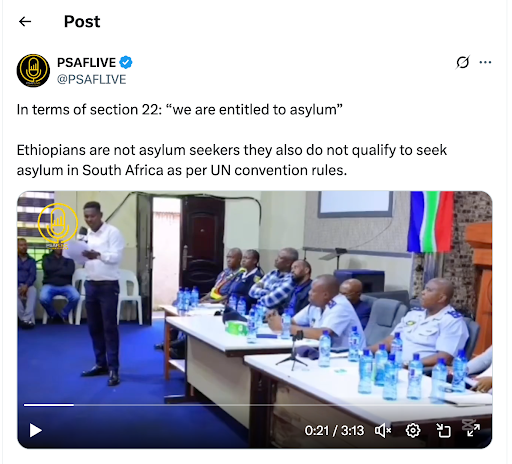
On 10 July 2025, PSAFLIVE posted on X that “In terms of section 22: we are entitled to asylum. Ethiopians are not asylum seekers, they also do not qualify to seek asylum in South Africa as per UN convention rules”.
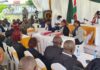
This post quotes an Ethiopian national addressing the South African National Police Service (SAPS), in what seems to be a dialogue between the community of Ethiopian nationals and SAPS. In the video, the man says from 5-10 seconds, “In terms of section 22: we are entitled to asylum”. In response to the video, PSAFLIVE indicates that Ethiopians are not asylum seekers; they also do not qualify to seek asylum in South Africa as per UN convention rules.
Anyone can seek asylum in South Africa, according to the Government Official Information Service. It states that “If you fled your country of origin for fear of persecution, and you do not have legal documents such as a passport or visa, you must apply for an asylum seeker’s permit at the nearest Refugee Reception Office (RRO)”.
To be eligible to apply for an asylum seeker’s permit; a person enters the Republic of South Africa through a port of entry (a land border post, airport or harbor), claims to be an asylum seeker and is, therefore, issued with a section 23 Permits which is a non – renewable “asylum transit permit” of the Immigration Act.
The permit is valid for 14 days only and authorises the person to report to the nearest Refugee Reception Office to apply for asylum in terms of Section 21 of the Refugee Act. The asylum seeker is required to furnish a section 23 permit, any proof of identification from the country of origin, and a travel document if in possession of one.
According to the general procedure for applying for asylum, the Government of the Republic of South Africa has an obligation to grant protection to refugees and other persons in need of protection under several UN Conventions, including the 1951 Convention Relating to the Status of Refugees.
There is no UN Convention that prohibits seeking asylum in South Africa. However, like any other country hosting refugees and asylum seekers, Chapter 1 of the Convention and Protocol Relating to the Status of Refugee Article 1, paragraph F states that, “The provisions of this Convention shall not apply to any person with respect to whom there are serious reasons for considering that”.
(a) He has committed a crime against peace, a war crime, or a crime against humanity, as defined in the international instruments drawn up to make provision in respect of such crimes.
(b) He has committed a serious non-political crime outside the country of refuge prior to his admission to that country as a refugee.
(c) He has been guilty of acts contrary to the purposes and principles of the United Nations.
On 11 March 2025, TikTok user Bonsi Chakiso Asheb posted a similar video to the one posted on 10 July 2025. In the video, the same man can be heard for 20-26 seconds saying, “We are the Ethiopian nationals residing in Hammanskraal and surrounding areas”. He continues to say on 53 seconds that “the majority of us who are gathered here today, we are asylum seekers who have left our home country because of the fear of persecution for reasons of race, religion, political opinions, and belonging to a particular social group”
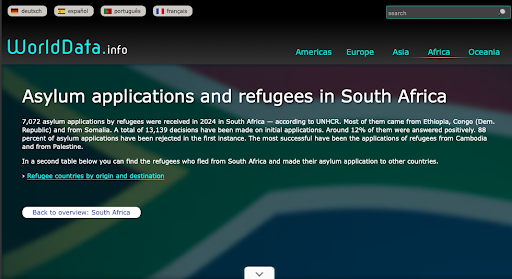
The Refugees ACT 130 OF 1998 (1D) For purposes of subsection (1C), a category of asylum seekers refers to asylum seekers from a particular country of origin or geographic area or of a particular gender, religion, nationality, political opinion, or social group. The World Data indicates that 7,072 asylum applications by refugees were received in 2024 in South Africa, according to UNHCR. Most of them came from Ethiopia, Congo (Dem Republic), and Somalia.
The PSAFLIVE comes in the backdrop of the ongoing protests in some parts of South Africa, in which organised groups such as March and March and Operation Dudula are preventing both legally and illegally documented foreign nationals from accessing health care services in local hospitals. They are indicating that foreign nationals are burdening South Africa’s health system.
The Department of Health has condemned the act of groups blocking access to health care facilities to deny treatment to patients who are undocumented foreign nationals.
TalkAfrica examined the X post claiming that Ethiopians do not qualify to seek asylum in South Africa and found it FALSE.
This fact-check was produced by TalkAfrica as part of the African Fact-Checking Alliance’s (AFCA) incubation programme. It was produced with peer-mentorship from Code for Africa’s fact-checking initiative, PesaCheck, with financial support from Norway. AFCA mentorship respects the journalistic independence of the researchers, offering access to advanced techniques and tools. Editorial decision-making remains with Name of Newsroom. Want to learn more? Visit: https://factcheck.africa/