|
Getting your Trinity Audio player ready...
|
By Diana Chiyangwa
Johannesburg, South Africa: TalkAfrica has verified that claims about KwaZulu-Natal having the highest HIV prevalence are false.
This Facebook post claiming that KwaZulu-Natal province has the highest HIV prevalence is FALSE.
On 12 June 2025, an anonymous participant posted on a Facebook page called Daveyton that “If Ujola Nomzulu Condom Condom” translates to “If you are dating a Zulu, use a condom.”
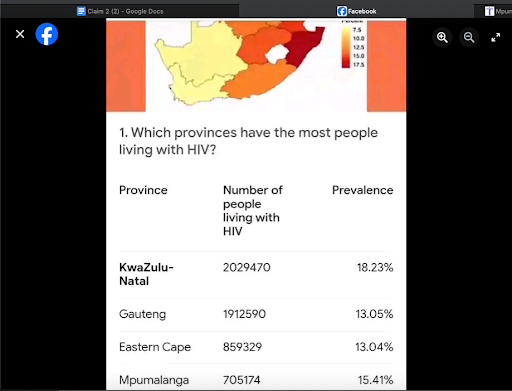
The post featured a screenshot with data indicating KwaZulu-Natal as the province with the highest number of people living with HIV, with 18.23% HIV prevalence. TalkAfrica can reveal that the source of the screenshot is from Spotlight, a website that published this data on 5 August 2019.
A report released by the South African Government News Agency on 25 September 2024 indicated that KwaZulu-Natal recorded the second-highest HIV prevalence rate at 16% in 2022, down from 18% in 2017. According to the Human Sciences Research Council Survey (HSRC), this translates to 1,980,000 people living with HIV (PLHIV) in KwaZulu-Natal, which was a decline from 1,990,000 in 2017. The information is based on the findings of the Sixth South African HIV Prevalence, Incidence and Behaviour (SABSSM VI).
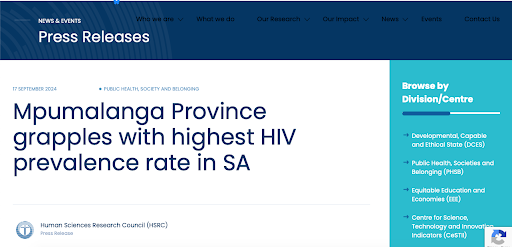
The latest study released by the South African Government News Agency, Mpumalanga, has the highest HIV prevalence at 17.4% in 2022, which translates to an estimated 890,000 people living with HIV (PLHIV) in the province. The latest data was released on 17 September 2024.
A press statement by The Human Sciences Research Council (HSRC) released the key findings of the Sixth South African HIV Prevalence, Incidence, and Behaviour Survey (SABSSM VI) for Mpumalanga Province on Tuesday, 17 September 2024.
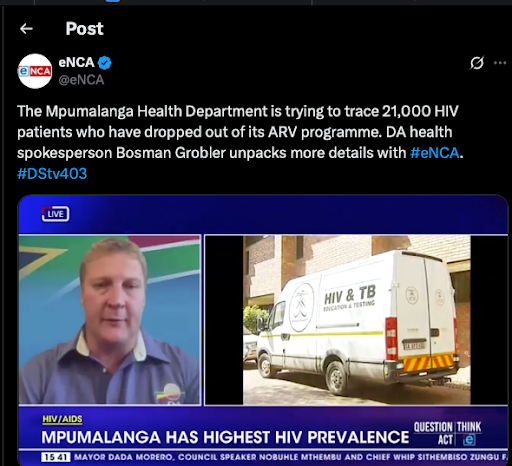
Bosman Grobler, Democratic Alliance Mpumalanga Health spokesperson, also indicated during an interview with eNCA that Mpumalanga province has the highest HIV prevalence.
TalkAfrica has examined a Facebook claim that KwaZulu-Natal province has the highest HIV prevalence is FALSE.
This fact-check was produced by TalkAfrica as part of the African Fact-Checking Alliance’s (AFCA) incubation programme. It was produced with peer-mentorship from Code for Africa’s fact-checking initiative, PesaCheck, with financial support from Norway. AFCA mentorship respects the journalistic independence of the researchers, offering access to advanced techniques and tools. Editorial decision-making remains with Name of Newsroom. Want to learn more? Visit: https://factcheck.africa/