
|
Getting your Trinity Audio player ready...
|
By Mercy Kachenge
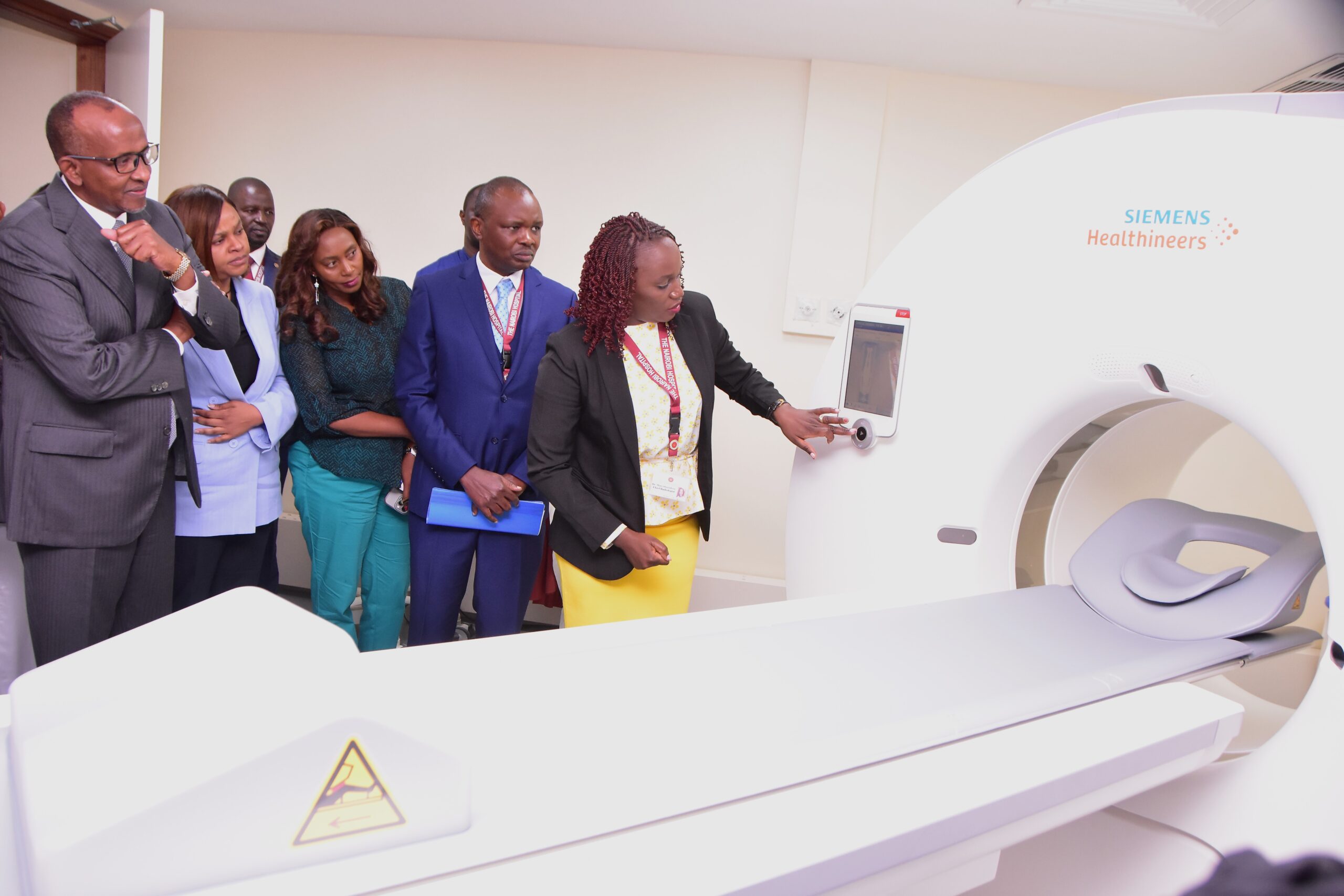
Nairobi, Kenya: The Nairobi Hospital has unveiled a state-of-the-art, AI-powered CT scanner as part of its commitment to transforming diagnostic care and advancing the fight against non-communicable diseases (NCDs) in Kenya.
The Siemens SOMATOM Drive 256-slice CT scanner is the latest in the hospital’s investment in smart healthcare innovation. To mark this milestone and enhance access to diagnostic services, the hospital is offering a 10% discount on all CT scan services from 15th June to 14th July, 2025.
Health Cabinet Secretary Hon. Aden Duale EGH commended the hospital’s role in building local confidence in Kenya’s healthcare system and reducing reliance on medical tourism.
“This is more than a machine, it is a life-saving tool that transforms how we diagnose and treat critical conditions. At a time when over 11,000 Kenyans seek care abroad annually, today’s investment reaffirms that world-class care can be delivered here at home. The scanner is a critical step in tackling NCDs through early detection, better outcomes, and more lives saved,” said Hon. Aden Duale.
 He also underscored the government’s commitment to Universal Health Coverage and called for deeper public-private partnerships in support of national reforms such as the Social Health Authority (SHA) and the “Lipa SHA Pole Pole” model to reduce the financial burden of illness on Kenyan households.
“I urge all healthcare institutions to align, collaborate, and innovate. Let us build systems that not only treat, but also restore dignity and protect livelihoods,” he added.
The Siemens 256-slice CT scanner is equipped with dual-source technology and AI-assisted imaging. It allows for faster, high-resolution scans with lower radiation exposure and less need for contrast agents. Applications include pediatric, cardiac, orthopedic, oncological, and neurological imaging, reducing the need for sedation in children and allowing full-body trauma scans within seconds while improving accuracy in patients with implants.
Dr. Barcley Onyambu, Chairman of The Nairobi Hospital Board, noted that the investment reflects the institution’s deep commitment to innovation and patient-centered care.
“More than a technological upgrade, this is a reaffirmation of our purpose: to lead with compassion and excellence. Our scanner enhances speed, clarity, and outcomes that are anchored in dignity. It is also a symbol of what is possible when African institutions are bold in vision and unwavering in quality,” he said.
Dr. Onyambu also reaffirmed the hospital’s readiness to partner with the Ministry of Health and the SHA to ensure that more Kenyans access global standards of care locally, citing ongoing efforts toward Joint Commission International (JCI) accreditation and continued professional training through the Cecily McDonnell College of Health Sciences.
The Nairobi Hospital CEO Felix Osano said the new installation was part of a broader strategy to make diagnostics more people-centered.
“This scanner enables us to act more quickly, reduce waiting times, and improve accuracy – whether for a child needing answers, a trauma patient needing urgent care, or an elderly patient needing clarity. For doctors it means better planning, for patients it means faster and safer care, while for the system, it means efficiency,” he said.
Osano added that the scanner complements other recent upgrades in radiology, including improved MRI, mammography, ultrasound services, and 24-hour reporting, alongside decentralized diagnostics through the hospital’s outpatient network.
“At The Nairobi Hospital, we are building a future where Kenyan patients no longer need to travel for quality care. And by easing access through this discount, we are ensuring that cost is not a barrier to life-saving diagnostics,” he said.